In the nearly eighty years since the horrific events of the Holocaust took place, many works of art, both in literature and in film, have drawn inspiration from it. Most of these stories are about the Jewish people themselves, such as The Pianist. Some of these are about the allies of the Jews, who helped them hide from the Nazis, including arguably the most famous Holocaust film, Schindler’s List. Rarely, if ever, do we see a story about the Holocaust that shows the perspective of the gentile people who either aided the Nazi forces or refused to intervene as they saw their Jewish community members taken from their homes. In 1945, Ferenc Török’s 2017 Hungarian film based on Gábor Szántó’s short story Homecoming, we see exactly this. While the events of the film take place after the Holocaust, it still looms over the characters’ heads as they brace for a new reality where they may have to pay for the sins they had committed against their Jewish neighbors.
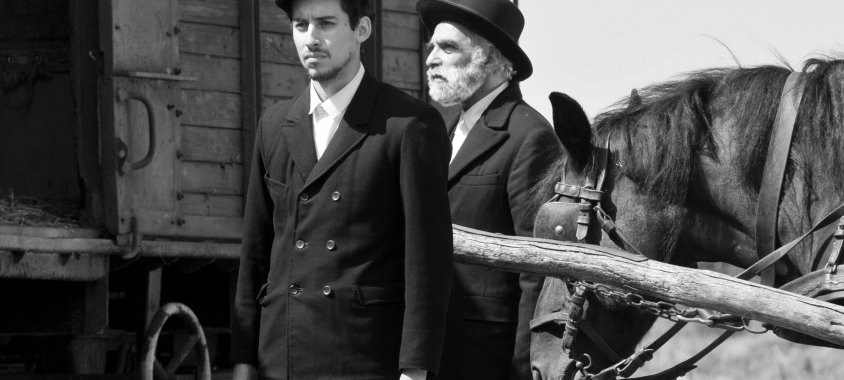
1945 tells the story of a village in Hungary where the Jewish people had been taken away during the Holocaust and their possessions, such as their houses and stores, are occupied by the remaining gentile villagers. Two Jewish men arrive at the village by train. They bring with them boxes of goods including perfumes, the sound of which stuns the stationmaster as well as the villagers he relays the message to because the town’s drug store had belonged to a Jewish family. As word of their arrival spreads around the village, the townspeople are confronted with their fear and guilt and react in different ways. In the end, it is revealed that the Jewish men were not there to reclaim any property, but were there to honor the Jewish villagers, who had presumably died during the Holocaust, by burying their possessions.
To the townspeople, the arrival of these Jewish men signifies more than just lost property, it is a sign of the end of the world that they had known for the past few years. The film is shot like an apocalypse movie for that reason. Ominous music haunts the audience for most of the film as the Jewish men walk towards the village. Their march towards the village with the rhythmic clip-clop of the horse pulling their carriage resembles a doomsday clock, counting down the seconds until the Hungarian villagers’ will have to face their fate. As they make their way towards the town, the intensity and urgency with which the townspeople react is also amplified, another characteristic seen in films prior to an apocalyptic event.
Beyond the cinematography and sound editing, the characters exhibit behaviors commonly seen in apocalypse movies. The characters of Kustár, Arpad, and Istvan reflect the three common reactions to an eminent doom: accepting the end and appealing to a higher power instead, escaping fate by fleeing, and staying and fighting their fate. There is also the character of Jancsi who represents the prophet, ready to accept the end of the current world in favor of the Russian-influenced “new world,” which he repeats to Istvan. These characters’ actions and emotions further drive home the idea of the current world ending, which was true for Hungary at the time, as it quickly transitioned from a fascist regime during World War II to a Soviet-supported Communist one by the end of the decade.
The film effectively captures the sentiment towards Jews, Russians, and the overall uncertain future in Hungary at the conclusion of the second world war. The payoff after the buildup of tension is anticlimactic but very moving, as we see the Jewish men were not there to seek revenge or reclaim their property, but instead to do exactly what people had been doing around Europe – bury the memories and possessions of the Jewish people. However, it is not as easy to bury their stories as long as we have storywriters like Szántó and Török keeping their memories alive.
by Pranav Darbha

 Budapest through Streets, People and Cinema