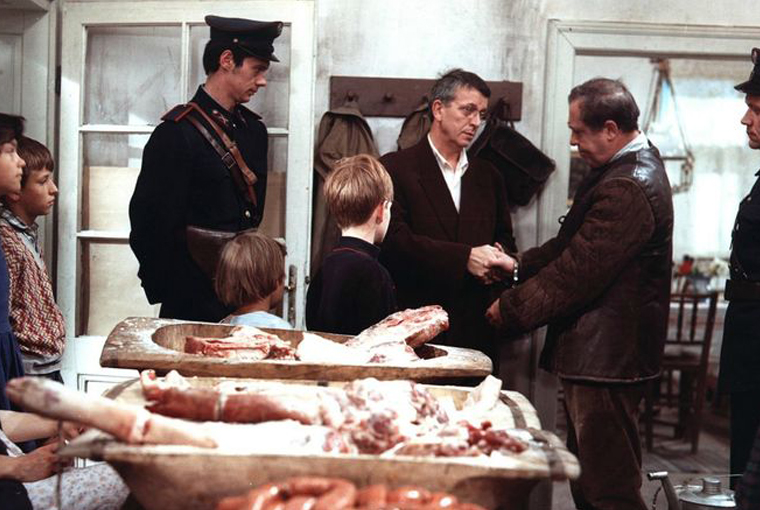
Péter Bacsó’s “The Witness” is a bold piece of satire about life in the state communism period of Hungary. Though it is a Hungarian cult favourite, it remains largely unnoticed in countries further West. It’s definitely worth a watch – “The Witness” reveals so much about the time and place it describes, being simultaneously deeply entertaining and also acting a record of the unsettling state of Hungary under communism. Although it tells a story of a Hungarian man, in Hungary, living under Hungarian communist rule in the 1960s, the themes of spectacle and political shenanigans that exists in “The Witness” can resonate with any audience in any country.
Jószef Pelikán (Ferenc Kállai) is a simple dike keeper who can be most accurately described as naïve. His wife has left him, so he lives in a small house with his many children. Despite being under the intensely oppressive communist regime, Pelikán is somehow blissfully unaware of the cruel nature of life. When he slaughters a pig in the first act of the movie to feed his family, Pelikán is arrested but quickly released thanks to the mysterious Comrade Árpád Virág (Lajos Öze).
Following this introduction, a series of jobs and favours are bestowed upon Pelikán by the mysterious Virág, even though Pelikán really just wants to return to his dike. The audience is as confused as Pelikán as to why he keeps getting promoted to increasingly important positions.
At some point, we learn why Virág has been so keen on helping Pelikán – he wants him to falsely testify against his friend Daniel Zoltán (Fábri Zoltán), a minister no longer in favour with the prevailing regime. The rest of the movie follows Pelikán as he feebly tries to break away from the (both metaphorical and tangible) script that the government has given him to perform, despite the pressure to do otherwise.
The use of comedy to tell the story in “The Witness” is deliberate and intelligent. “The Witness” isn’t at all avant-garde, not does it take itself very seriously. It is understandably a Hungarian cult classic – by being this way, the movie becomes much more accessible to the public, and can spread its message much more effectively. In contrast to many films about communist Hungary, which highlight the injustices of the era by telling stories of loss and tragedy, “The Witness” uses humour and hyperbole to demonstrate the sheer absurdity of the political system that existed then.
A scriptwriter preparing Pelikán’s testimony for Comrade Daniel’s trial is excited to have incorporated a novel idea in his story – fascist frogmen receiving messages from spies in the Danube. The spectre of communism comes alive in a horror ride in a socialist amusement park, in one of Pelikán’s attempt to please the ruling party.
Despite the humour, the rhythmic rise and fall of Pelikán, who repeatedly gets imprisoned just to be released almost immediately, also expresses a truth. It speaks to the fickleness of those in power, how everyone is just a pawn in a greater game, and how powerless you are to your own fate in such a world as 1960s Hungary.
At the same time, “The Witness” has a few serious moments, and those shine by how they reflect sad realities. In one scene, Pelikán is praised and honoured after ‘successfully’ developing the first Hungarian orange (a lemon). Afterwards, while sitting at an opera performance in honour of the successful orange researchers, Pelikán tells Virág he feels guilty for having deceived the people. Virág responds, saying that this pleases those in power, pleases the researchers, and sends a message to the imperialists. He tells Pelikán: “We made no empty promise,” because the truth doesn’t really matter when appearances are all that count.
“The Witness” is brave in a way that may be hard for a modern audience to appreciate – when it was released in 1967, the Communists still governed Hungary, and as a result it was banned until 1981, when its international release pressured the Hungarian government to let the film be shown in Hungary as well. In its own way, “The Witness” stands up to the same government power that Pelikán resisted. The movie is powerful in itself, but the context makes it even more so.
It is heart-warming too – we see Pelikán use his ignorance and foolishness to his advantage when he is asked to betray his friend, by faking an inability to learn lines. Pelikán is the David against the Goliath that is state communism, and his moral stand is a triumph we can all appreciate. In the end, the audience appreciates him for this quality; in a world full of sly and opaque men like Virág, Pelikán’s honesty and his principles represents the human in us all.
- Title: “The Witness” (“A Tanú”)
- Director: Péter Bacsó
- Year: 1967
- Country: Hungary
by Daphne Poon

 Budapest through Streets, People and Cinema