“Time Stands Still”, a 1982 Hungarian Film directed by Péter Gothár, gives a uniquely charming coming of age story in the years after Hungary’s 1956 revolution. Beginning with two young brothers watching their father flee to Austria from the crumbling streets of Budapest after a failed uprising against the Soviet occupation, the film fast forwards to the boys in high school, having remained in Budapest with their mother. The story centers around the younger brother, Dini, who experiences what on the surface looks to be a very relatable high school experience. Dini develops romantic interest in another student, Magda, with whom the majority of his interactions are as awkward as the typical portrayal of high school romance. Aside from his romantic interests, Dini navigates the authoritarian structure of his high school during the times of communist occupation. Although a menacing authority enforces a strict disciplinary culture in the school, multiple role models influence Dini to reject such an authoritarian culture and pursue a life of freedom. Students hold small rock and roll concerts which function as an escape from the tyrannical school culture, while even teachers hold underground gatherings and parties conflicting with the authoritarian culture of the school.
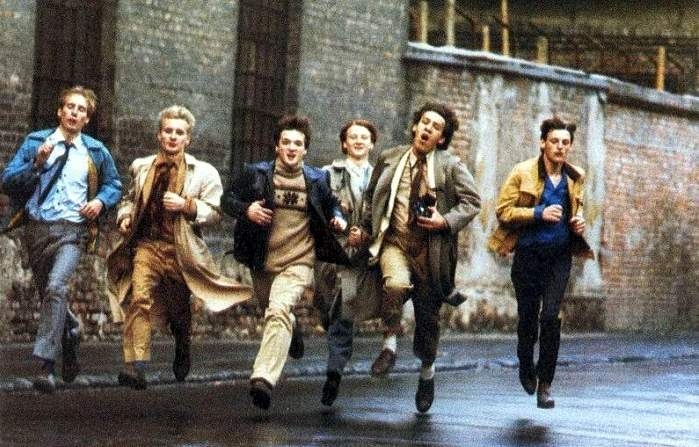
The mounting tones of hope for an escape to freedom boil over after Pierre, an almost stereotypical looking rebellious high school student, gets expelled from the school after standing up against the school’s authority. After tearing through the school, smashing various paintings and windows along the way, Pierre concludes his rebellious rampage crashing through the school’s window and falling out onto the street. With the rebellious culture having finally enveloped Dini, he and Magda excitedly follow Pierre in an attempt to flee to Vienna as Dini’s father once did. Yet just as it seems they are finally going to escape, Dini and Magda, having just had their first and presumably only romantic encounter, sporadically decide to stay in Hungary. After the film continuously builds up hope for these teens longing for freedom, it finishes with unexpected tones of failure. Pierre is never seen or heard from again after he leaves Dini and heads to Austria. Magda is last seen a few years later as the wife of a random man who appears to have great control over her life. Lastly, Dini is last seen as a drunken soldier who looks lost as he wanders the streets of Budapest having lost his sense of hope for a life of freedom.
Although the movie followed what on the surface was a story of rebellious high school students, it drew obvious parallels to the experience of Hungary as a whole underneath the communist occupation. In the beginning, it seemed as though the movie was shaping up to be a beacon of hope for Hungarian people under the Soviet regime. Dark scenes of Dini and his peers having to obey the authority of his school represent the oppression and lack of freedom of Hungary underneath the Soviet rule. As the story progresses, however, hope for an escape from the darkness continues to build. The repeated lyrics of the song “You Are My Destiny”, at one point even muttered by Dini as he stares from darkness out a light window, symbolize hope for a better future. Rock and roll music performed throughout the movie gives a feeling of rebellion and escape for not just the students, but the Hungarian people as a whole. The rising themes of hope and escape are punctuated as Pierre crashes through a window of the school, literally breaking free from its authoritarian regime.

Yet just as the movie seems to be building towards an ultimate representation of an escape to a better life, with dark scenes in basements being replaced by bright scenes at Lake Balaton, and oppression being replaced with the freedom of escape, the heroes of the story either inexplicably give up or disappear. All symbols of hope and escape are washed away, and viewers are left seeing characters who were once role models for hope themselves returning to their original place of oppression. What was once a symbol for hope for those who are oppressed, suddenly turned into a reminder that there may not be any escape at all.
Before the abrupt end to the story, “Time Stands Still” uniquely uses music and light to provide a charming perspective to an otherwise familiar coming of age portrayal. Most memorably, the use of music and light throughout the film grow to give unique insights into Dini’s character. The more times the lyrics “You are my destiny” echoed over a scene, the more it seemed these lyrics were coming from the inside of Dini’s own head as he struggled to figure out what exactly his own destiny was. Camera-like flashes of light in specific scenes seemingly serve as a representation for Dini capturing moments that he will remember, as if his memory is literally photographing moments that will end up having a great influence on his life. These techniques stretch beyond simple dialogue and interaction to provide a deeper understanding of Dini’s journey as he grows into a quintessential representation of freedom, or so it seemed.
Despite these clever looks into Dini’s character, nearly all understanding of his character is lost following the inexplicable loss of motivation to pursue the freedom he had been chasing for the whole movie. It once seemed that Dini would surely pursue a triumphant life free from the oppression he faced growing up. However, instead of a triumph, or even an explanation for giving up on his goals, the lasting image of this once complex and heroic character is a drunken soldier wandering the streets having abandoned his previous hopes. Thus, the once defining tones of hope and freedom of “Time Stands Still” are abruptly washed away by final moments of failure and oppression.

 Budapest through Streets, People and Cinema