“1945” opens with the mayor of a small Hungarian village in the bathroom, shaving his face while listening to the news on the radio describing the end of World War 2. His demeanor is nonchalant, which is indicative of how most of the villagers likely felt: although Hungary was occupied by Axis forces and was a major contributing force in the persecution of Jews in the Holocaust, the day-to-day life of its rural citizens was impacted far less than that of those living in Budapest. At least, that’s what an uninformed audience may be led to believe. In fact, the lasting impact of Hungary’s role in the war, as well as their acknowledgement (or lack thereof) of this role, is the focal point of Ferenc Török’s “1945”. Although released in 2017, the movie is an adaptation of the short story “Homecoming” by Gábor T. Szántó, published roughly a decade earlier.
The plot of “1945” revolves around two Jewish men, a father and his son, returning to the Hungarian village in which they lived before the war. Their journey is a long and quiet one, not expedited by the fact that they are transporting a wagonload of goods with them. Throughout the movie, the intentions of these men are not explicitly revealed. However, the mayor of the village is made aware of their imminent arrival by the conductor of the train the men arrived on, and the village quickly becomes tense as rumors of the Jewish men begin to circulate. Although the villagers have various differing beliefs of what these men intend on doing once returned home, all of them are starkly aware of the fact that most of the deported Jewish community’s belongings are now in the remaining villagers’ possession. There is a palpable dread that these two Jewish men have come to claim their homes, their valuables, and perhaps even their revenge. As the movie progresses and the father and son travel to the village, the tension, apprehension, and vitriol of the villagers become tangible before reaching a boiling point at the movie’s climax, when the two men inevitably reach their destination.
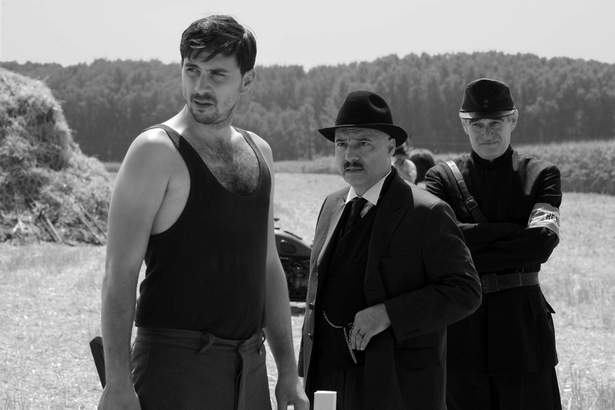
Filmed in black and white, the movie’s tone is decidedly bleak and tense. The camera angles, distant music, and anxious acting combine to create a stressful viewing experience: while watching the movie, I felt as though I, too, were afraid of what these men would do once they reached town. In the shots depicting the father and son walking through town, the camera is always peering through a window or fence, putting the audience in the shoes of a frightened villager. There are scenes in the film with little to no dialogue which seem to stretch on much longer than they actually last. And, throughout the entirety of the film, the acting becomes visibly more distressed: clenched fists, sweaty brows, and raised voices contribute to the rising stress and tension.
Although the viewing experience was certainly a stressful one, this stress proves critical to the interpretation of the film. “1945” seeks to address Hungary’s long-unacknowledged role in the Holocaust. Due to the practically immediate Soviet occupation of Hungary following the war, its citizens were not allowed to discuss the war, its politics, or – most importantly – the implications of their assistance in identifying and deporting their Jewish peers. In the modern era, where most of the world has taken the time to process and reconcile with the atrocities of World War 2, this is still a touchy subject for many Hungarians. By creating this film in 2017, the filmmakers take every creative liberty at their disposal to transport the audience back to 1945 and, in doing so, allow them an opportunity to process the Holocaust when they ought to have done so. Nowadays, it is easy to think of World War 2 as a distant historical event which has little impact on our daily lives, but Ferenc Török attempts to shatter this notion by asking his audience, “What would you have done in this situation?” I think most viewers will be surprised by how they answer this question at the film’s conclusion.
Contextualizing “1945” is not an easy task: it does not conform to typical genre expectations, its plot isn’t exactly clear without previous knowledge of the topic, and it uses a historical context to pose existential questions to its audience. Because of this, it is unlikely for audiences to have a universal experience or impression of this film. Personally, it played out almost like a horror movie for me; incredible suspense kept me on the edge of my seat for the entirety of the film’s running time, and I was filled with a sense of dread that the villagers would do something horrible to the Jewish men upon their arrival in town. This same dread had visible effects on each character, which manifested in a marriage’s abrupt cancellation, arson, and even suicide. In fact, the film reminded me so strongly of a horror movie that I found my self half-jokingly wondering, “Which character is going to end up being the murderer?” This sentiment, although humorous on the surface, actually plays directly into the filmmakers’ intentions: this slow realization – that each member of the village, whether father, mother, or child, was willing to be the murderer – is an epiphany that many Hungarians have still not come to terms with today.
Although“1945” does suffer from a slow-moving plot, several under-developed characters, and the general sense that it would have served better as a short film instead of a feature-length one, it is a memorable viewing experience unlike anything else. The historical context, haunting cinematic decisions, and unsettling philosophical implications combine to create an unforgettable film that is likely to stay with audiences long after the credits roll.
1945
Director Ferenc Török
Writers Gábor T. Szántó andFerenc Török
Running Time 1h 31m

 Budapest through Streets, People and Cinema