Wasay Qureshi reviews László Nemes 2015 Oscar winner, a disturbing and thought provoking film about the holocaust and the meaning of heroism.
“Son of Saul” is a Hungarian Film directed by László Nemes, with protagonist Saul Ausländer, a Jewish-Hungarian prisoner who has had to take up the job of disposing the bodies of the victims of the holocaust in a crematorium. When he comes across the body of a boy in the crematoria, Saul is driven by a burning desire to give him a proper burial, and the movie follows him in his attempts to do so. Given the backdrop of the Holocaust, Saul is fighting a losing battle in defying his orders when it comes to the boy. Son of Saul expertly explores the oppressive nature of this Herculean task through technical elements such as the movie’s cinematography and sound design, and character of Saul itself.
With a 4:3 aspect ratio and a field of view that almost never leaves Saul’s back, the direction of the movie’s cinematography is one that is extremely claustrophobic compared to most other films. In making these design choices, the viewer is made to feel like they are right there with Saul, experiencing the hardships and horrors of the holocaust for themselves. The viewer sees on screen almost exactly what the character of Saul sees in the movie, and the aspect ratio and close up camera angle make it almost necessary that the viewer’s attention is brought to the subject matter on screen, no matter how harsh it may be. From dead bodies to intimate conversations between prisoners in concentration camps, Son of Saul showcases an explicit picture of the Holocaust, one which many other movies about the historical event do not. The sound design is equally explicit and haunting. It matches the visual component of the movie in that it also stays true to depicting the sounds around Saul. The audience is made to hear sounds ranging all the way from loud weapons going off and people screaming in response to the hushed tones of prisoners doing their jobs in harrowingly quiet halls of concentration camps. The musical score complements the rest of the sound design — it comprises of orchestral elements and choirs, which adds to the bleak atmosphere. The musical score is not too loud, and is only sparingly used in the background. When paired with the equally oppressive story elements of the movie, choices in sound and shot design start playing an even bigger role as they complement Saul’s perilous attempts of giving the boy a proper burial.
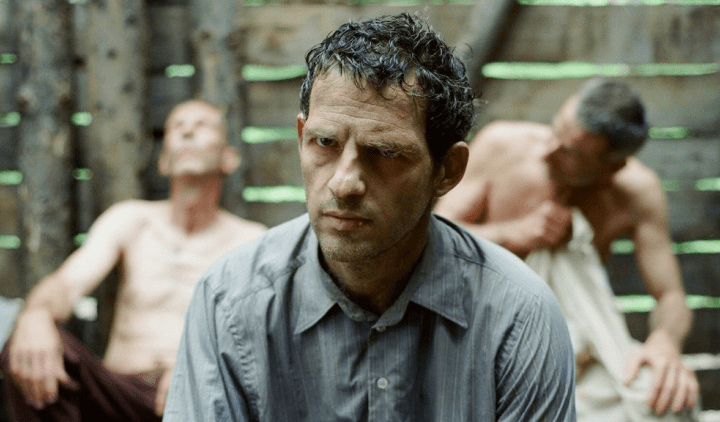
The character of Saul further amplifies the otherwise dark tone of the movie as well. Saul is a man who has seemingly lost everything to the ongoing holocaust. At the start of the movie, a viewer may almost believe that Sual has made peace with his fate as worker in a crematoria and does not have any ambition or expectation left in his life. However, this complacent attitude completely disappears when he comes across the body of the boy, who he claims is his son. While the audience is never explicitly told whether or not the boy is actually his son, they can draw interesting conclusions about the psyche of Saul regardless: if the boy isn’t Saul’s son, the movie is exploring the journey of a man who, having lost almost everything else, is trying to latch onto whatever ounce of meaning he comes across in life. For Saul, this is the justice he perceives the boy is owed in getting a proper burial. On the other hand, if the boy is indeed Saul’s son, the movie then becomes about a man’s quest to do right with the one important person he has left in his life when everything else has been lost. In both of these perspectives, Saul is a man that has lost a lot of important things in his life to the war, and actor Géza Röhrig igeniously conveys this through his acting. He plays a man that has mostly resigned himself to his fate, but is driven by a focused resolve to do what he believes is right. He keeps to himself, and does not let anyone else convince him to change his course of action, even if these actions put Saul and his fellow inmates’ lives and freedoms in jeopardy. Even when the credits roll, the audience is left to question Saul’s character and what his motivations were, or why his motivations to give the boy a proper burial were so strong to begin with.
With its painfully honest and brutal characters, storytelling, and production choices, Son of Saul is a gripping movie that keeps viewers glued to the screen. It does not revel in its graphic depictions of violence, yet does not shy away from such depictions either. In doing so, it tells an oppressive yet engrossing story that critics and audiences alike enjoy.

 Budapest through Streets, People and Cinema